



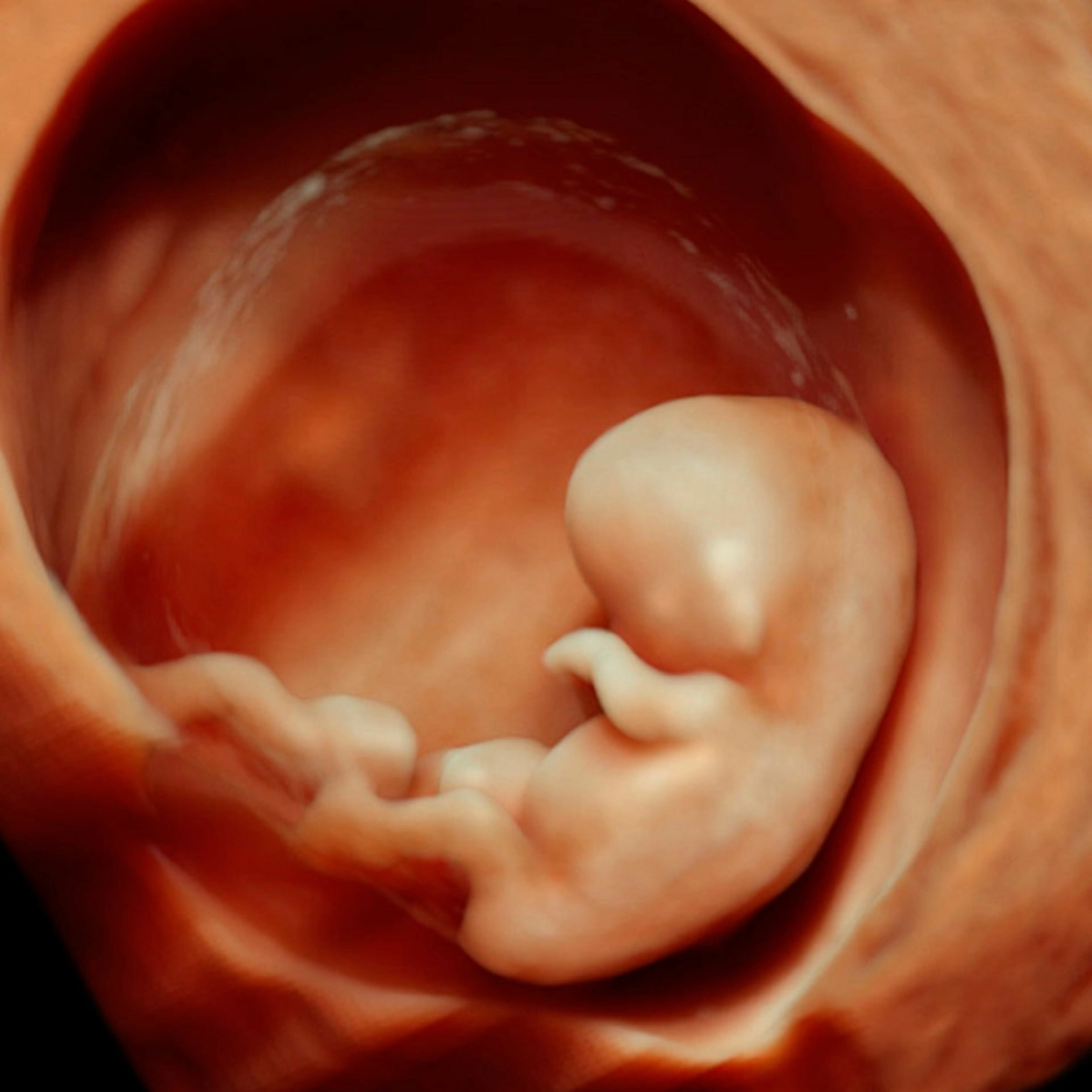
12 weeks old embryo weighs around 30 gr and is around 5 cm long.
Most people (in the Faroe Islands) agree that there are special difficult circumstances where exceptions can be made and permission should be granted for abortion. Therefore this question is being asked: So why not make a law that allows abortion because of those difficult circumstances? Why not make a law on exceptions instead of a law on free abortion?
By Elin Brimheim Heinesen
To answer these questions, we need to look at what “free abortion” actually means in practice. Free abortion simply means that the woman herself can freely decide whether to have an abortion in a difficult situation, rather than the doctor and/or the authorities deciding for her what constitutes a “difficult situation.” She knows that best herself. It should also be said that no woman “chooses” abortion just for fun!
What is a “difficult situation”? In a sense, it doesn’t matter what others think constitutes a “difficult situation” for a woman, because who can define that better than the woman herself? Can others better assess what a difficult situation is for her? And how difficult her situation is? Can (male) politicians sitting in parliament assess that better than the woman herself? No, they can no more do that than doctors can, so why should others have the decision-making power over the woman rather than the woman herself? Is it because women aren’t trusted?
What is an “exceptional case”?
Most people support allowing abortion in exceptional cases, but then the question is what exactly those exceptional cases should be—and when they can allow abortion.
What if a woman is scanned in the twentieth week and finds out that the baby she was so looking forward to bringing into the world has not developed vital organs?
What if a woman is assaulted on her way home from work and, a month later, is devastated to have to acknowledge that her attacker has planted his seed in her, as she now sees that the pregnancy test result is “positive”?
What if a woman starts bleeding because there’s a tear in the placenta, forcing her parents, husband, and children to face the impossible decision of whether to save her life or that of her unborn child?
What if a little girl has her innocence torn away by someone she should have been able to trust, and whose 11‑year‑old body is not mature enough to bear the consequences of that betrayal?
What if a woman’s partner decides to leave her, so she has to work two jobs just to make ends meet, and now must choose between bringing another child into a life of poverty and hunger, or having enough food for the children she already has?
What if a woman has to acknowledge that in no way—financially, emotionally, or physically—is she capable of raising a child?
What if a woman’s fertility treatment results in six fertilized eggs, and she is not allowed to reduce the number of embryos to best ensure that she herself and the remaining fetuses can survive?
What about the woman who has finally found the strength to flee her physically and psychologically abusive husband, only to discover she is carrying the beast’s fetus?
What about the woman who, after years of trying to get pregnant, goes for a check‑up only to be told there is no sound where heartbeats should be?
What about the high school girl who loses her virginity, but the condom breaks, and now she must choose between being a teenage mother or simply being a teenager?
What about the woman who has just discovered she is in the thirteenth week, but the egg never left the ovary, so she must choose between an abortion or risking death from internal bleeding?
Where should the line be drawn?
If you think any of the above examples should allow abortion, and at the same time think we are dealing with “children” in the womb before the 12th week, then in some cases you are yourself advocating “child murder,” as you might call it.
On the other hand—if you do not accept any exceptions, then you are in effect saying that the risk of women dying is acceptable—in essence, you are indirectly endorsing “femicide.”
So where do you set the limit for when abortion should be allowed? And why do you think you are better qualified to assess that than the woman herself? Is it because you don’t trust women’s judgment? After all, she is the one who must live with the consequences. Not you. And you have no idea what reasons women have for choosing abortion.
Some say that free abortion is simply about being able to choose an abortion for no other reason than not wanting that particular child. The same people often believe that there are women who just use abortion as contraception. Such a viewpoint is unfounded and nothing but a crude expression of distrust of women.
Having an abortion is in fact a very unpleasant and potentially dangerous procedure, which no normal woman would think of choosing as a contraceptive. And if any woman really showed such irresponsibility—which I highly doubt—she would in no way be qualified to bear a child or become a mother anyway. No, there is absolutely no doubt that no woman chooses abortion for fun. To claim otherwise is deeply offensive to womankind as a whole.
Those who oppose free abortion say that each individual cannot be allowed to choose when to deny others access to life. There must be clear rules in this area. There is no doubt that the clearest possible rule is that the woman must make the decision about whether she is able to have a child or not.
It is perfectly fine to set a clear rule, such as a time frame of, say, 12 weeks, within which the abortion can take place. But to take the decision away from the woman and go on to set all sorts of more or less questionable rules for exactly what can legitimize an abortion within this period or not—is, firstly, almost impossible to define clearly, because the circumstances can be incredibly varied. And secondly, it is in any case a gross restriction of the individual woman’s right to control her own body.
The authority is taken away from her and instead handed over to officials who must make the decision for her, and who do not have the same insight into her situation as she herself does. Entrusting the responsibility to others who in no way know better than the woman what is best in her situation—and letting them decide whether permission should be granted for an abortion or not—is a much murkier and less clear‑cut rule, because there are so many different considerations to take into account that might work on paper, but in practice people can have very different opinions about them and thus make far too uneven decisions.
This is, not least, a tremendous humiliation of the woman, who is forced to accept being weighed and measured in every way by people she may not know at all, and must rely on their mercy.
Should the fetus then have no rights?
That is a question those who oppose free abortion ask. But what do they mean by “rights”? Should a fetus in the womb have the same rights from conception that children who are born have? Should they, for example, have an ID number from conception? Should fathers, for example, pay child support from conception?
They are probably thinking of the fetus’s right to life. One argument is that if abortion is not performed, a child might be born a few months later—but it doesn’t really make sense to talk about a “right to life” in this case, because then preventing any and every fetus from developing into a child would be “killing” or “murder.” Do people then mean that every woman who, for example, uses an IUD is a murderer? Of course she is not, among other things because we are talking about an embryo, not yet a “child”—and therefore it cannot have the same rights as a child.
Those who think abortion is about “taking the life of a human being” still say there are situations where, for example, the mother’s life and perhaps also the child’s are at stake, where exceptions must be made. But exactly where that line lies, they do not seem capable of saying. Yet this obviously matters—a great deal—especially that our elected officials take a clear position on this issue. For if free abortion is NOT to be allowed, it is crucial to know what our politicians think about the specific cases in which abortion could then be permitted.
What about the “right to life” of fetuses in those exceptional cases that people otherwise accept as legitimizing abortion? If people are to be consistent, then they must mean that there should be no exceptions, right? And if they do think there should be no exceptions, are they then willing to let women’s lives be sacrificed so that a fetus can live as long as possible in the womb? Even if it endangers the mother and the fetus will die anyway if the woman dies? And if they don’t mean that, can they then be clear about which exceptional cases they believe should allow abortion? Because just speaking in generalities muddies the debate. Let’s be concrete.
Here I am thinking especially of our dear members of parliament, who represent the people. As citizens and voters, we have the right to demand that our MPs be clear about what exactly they think about this. It is not enough to simply say one is “against abortion.” This is a much more complex issue than that—as the examples at the top of this post show. We would very much like to know how MPs think cases like these should be solved politically if abortion is not to be free.
But our legislators quite evidently cannot answer that, because no one else can say with certainty either—not even doctors—at least not better than the woman herself. That is, to assess precisely where the line should be drawn. Therefore it is wisest that the woman makes the decision herself. Not because the woman always knows better than the doctor whether her life or the child’s life is at risk, but of course she must in all cases be able to decide in consultation with the doctor and have the final say about what she wants after the doctor has informed her about her and the fetus’s health.
Is a fetus “a child”?
I understand that those who are against abortion see a fetus in the womb as a “child” from conception. But a fetus that cannot survive outside the uterus cannot yet be called a child. If, on the other hand, it is developed enough to survive outside the womb, then it can be called a “child” and then also has the right that everything possible is done to ensure its survival.
Until then, the fetus’s “right to life” cannot outweigh the woman’s right to her own life—that is, to control her own body. A woman must be able to refuse to undergo an unwanted pregnancy, which is not entirely risk‑free and can potentially endanger her own life. In exactly the same way that anyone has the right to refuse to be forced to give one of their kidneys to someone who needs it to survive. Their right to live does not outweigh your right to control your own body, including your kidneys.
In that case we are even talking about adults, conscious people who know what they lose if they lose their lives. A fetus is not yet conscious of itself and therefore does not know what it loses. So it is a bit meaningless to talk about an unconscious fetus that cannot survive outside the womb having a right to life greater than a woman’s right to control her own body.
It does make sense, however, to set a time limit for when abortion can be performed, because the fetus does develop more and more into a child. But a fetus is not a child (yet), and therefore cannot have the same “right to life” as a child that has been born alive—at least not in the first 12 weeks, when it cannot live outside the womb anyway. And not when that right is weighed against the woman’s right to control her own body. It is another matter when the fetus is so developed that it can survive. Then it is a child with the rights any child should have.
If we are NOT to have free abortion, where the woman is authorized to control her own body (the same authority a man has over his own body, because no one can legally force him to have his body/organs used for something he has not consented to), then who should make the decision in cases like the ones I mentioned above? Should these women be forced to go through a pregnancy they in no way want—or perhaps cannot even complete? Who should make the decision for them? And why should that party have more authority over their bodies than they themselves have?
The fetus is not an organ, no, but the uterus is! And the woman should have the right to control and have the final say over what her uterus is to be used for—or not used for. From that perspective, the examples I mentioned are clearly relevant and can be used as arguments for free abortion.
The difference between the viewpoints of those who support and those who oppose abortion is that those who support it do not—unlike those who oppose it—equate a fully developed, conscious human being with an undeveloped, unconscious fetus before the 12th week. Although it can potentially develop into a child, it is not that yet. And it can never be conscious of what it has “lost.”
Therefore, free abortion is not ethically reprehensible. And therefore it is acceptable that a woman has the right to terminate her pregnancy before the 12th week, if she believes that is the wisest thing to do in her situation—both for her own sake, because she does not have the strength to go through a strenuous, possibly life‑threatening pregnancy and to bring a child into the world that she knows she cannot take responsibility for—and likely also for the fetus, which avoids being born into a home or a situation that the woman knows for certain is not suitable or in any way good for the child to be born into.
Those who oppose free abortion say they believe that a child in the womb has a “right to life.” Yes, I also believe that a child (i.e., one that has been born) has the right to life—and not only the right to life, but also the right to a dignified life. I would honestly wish that people who want to protect fetuses were just as eager to protect children who have been born. But it often seems they are not as concerned about that. Many seem to shrug or completely ignore it when one talks about the rights to a dignified life of children who are born —for example, the rights of those poor starving children in Gaza—just to name one example of the hypocrisy of many who say they want to protect fetuses but do not protect children who have been born with the same zeal.
What about protecting the rights of the person who, in this context, actually is a fully developed, conscious human being—namely the woman. Why should she have no right to a dignified life and to control her own life and body? Why should she have far fewer rights than people want to give the undeveloped, unconscious fetus? Should she simply be stripped of all rights over her own body and be seen as merely an incubator because she is pregnant? She is a whole person with her own life and dreams—not just a host body or a birthing machine. Why should she suddenly have nothing to say about what her body is to be used for?
Do we really want to return to those terrible times when far too many women either died or suffered lifelong injuries because they were forced to go to quacks to get an abortion? I personally know of several cases of exactly that, and what devastating consequences it had.
Banning abortions does not prevent abortions. It only prevents safe abortions.



