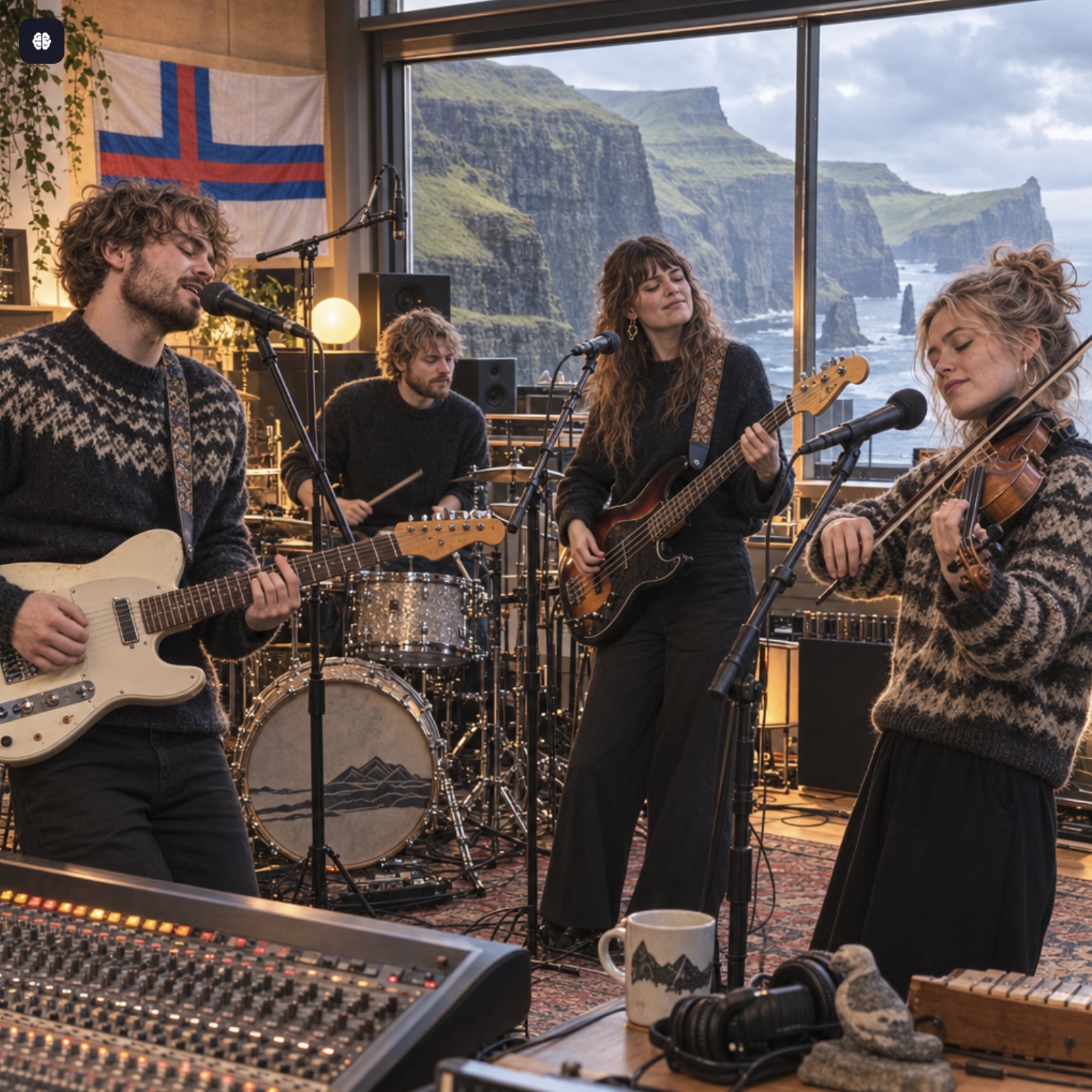
If an industry is to become profitable at all and develop into a significant source of income for the country, the most important precondition is that the public sector secures good infrastructure for the industry. This applies to all industries — not least the music industry. But we have a Minister of Industry who seemingly has difficulty understanding how crucial it is for the country’s industry as a whole — including the music industry — that public investments are made in good infrastructure. What a pity that the minister fails to see the opportunities his foreign colleagues spotted long ago — namely, that it pays to help the goose that lays the golden eggs take flight — the golden goose that the music industry could become. Instead, he chooses to clip its wings just as it had fledged and was getting ready to lay its first golden eggs.
by Elin Brimheim Heinesen, 24 Nov. 2026
The Minister says that an industry cannot be a real industry if it cannot manage without an appropriation in the Finance Act of just one million kroner, because an industry can only be an industry if it manages to stand on its own feet and finance itself. But in this he is completely wrong.
If we can show that, for example, our largest industry — namely the fishing industry — is at least as dependent on public investment — probably more so than the music industry, relative to its size — and how crucial public investment in infrastructure is for the fishing industry, we can only hope that the Minister will see the parallels between the fishing industry and the music industry. The difference is smaller than the Minister perhaps thinks, because an industry is an industry, no matter what product the industry sells. What applies to the fishing industry and to industry in general of course also applies to the music industry.
Before fishing could become a professional and profitable industry that got on its feet and could take off, all kinds of preconditions first had to be in place. Society as a whole had to be organised in a way that supported this industry. It costs far from nothing to exploit the natural resources in Faroese waters. Someone had to invest in building the fishing vessels and the filleting plants. But the private investors who did so have by no means created all the necessary preconditions for fishing to become a profitable industry.
The industry cannot survive without the taxpayer
Before the fish could be caught and processed; before the products could be adapted to the market and quality-assured to such an extent that the fish products could become saleable and competitive, so that professional salespeople could sell the products on the international market; yes, before it was even possible for the fish products to end up in the freezer counter in the shop, where people could buy them, so that they could begin to generate a proper income for the shipowners, the filleting plants and the shareholders — and truly create jobs and income for the country — enormously large public investments were required in a huge underlying infrastructure, which the country — that is, the taxpayer — had to finance.
That is to say, people first had to be educated to design, plan and build the harbours, the roads, the ships and the plants and other facilities that the industry needed in order to function optimally. People had to be educated and trained to invent, develop and produce the fishing gear and production equipment; to know how to operate the ships; to know how to handle and maintain the machinery; to know how to develop the product; to know how to ensure food safety and product quality; to know how to sell the product and build up an effective sales force; and generally to know how to administer and run a competitive fishing industry, where the country, with its embassies, and private industry cooperated to expand the markets, so that the fish could be sold as widely around the world as possible. For this, considerable investment had to be made in research, development, education, administration, representation, etc. — all such things that do not pay for themselves, but which are nevertheless an absolutely necessary precondition for the fishing industry, if it is to pay off.
The country has made huge investments in this absolutely necessary infrastructure for the fishing industry, before the industry could recoup the investment and really get on its feet. And this is still the case: Someone has to pay for all these preconditions to be continuously in place, if we are to have a fishing industry at all.
Prioritising industrial development is essential
But no investment comes with a full guarantee. It has certainly not always paid off to invest in fish. Far from it. Many investments in fishing vessels, filleting plants or fish farming have not borne fruit, quite simply because the activity did not pay. The plants went bankrupt. Just think of how many fish farms went bankrupt in the beginning, when attempts were made to develop the aquaculture industry. But still no one said: “No, this is not worth bothering with! We should rather stop spending money on such nonsense and go back to having fishing just as a leisure pastime!”
No, that was not the case. People did not stop investing in the fishing or aquaculture industry because of that. The country did not stop investing in creating good conditions for exploiting the fish resource. The imagination was still great enough to see the opportunities in the resource, because we knew that there was nothing wrong with the quality. So people rolled up their sleeves and embarked on new projects. No one lost respect for those who did not succeed — or called them social parasites, even though the treasury paid dearly to keep alive activities that there was no guarantee would be profitable.
And look today. It took its time, but the fishing and aquaculture industry has today become the cornerstone of our society. That was not only because we had access to the resource, but indeed also because we prioritised doing what was needed to utilise this resource and develop this industry. We believed in the opportunities, we took the risk, and we made the necessary investments, and the country — i.e. the taxpayer — helped by financing the preconditions.
Just as fishing developed into something other and more than it was when people each went down to the shore to fish with their own handline and lived hand to mouth, music can of course also be something other and more than just a leisure pursuit for a few eccentrics.
Product development a precondition for a profitable industry
Just as it is necessary for the fishing industry to invest in product development, so that high-quality and competitive products emerge in the end, so it is also necessary to develop music as a product. Like the fishing industry, the music industry also needs a well-functioning infrastructure. It is a precondition for the development of the industry that investments are made in developing talent, that there are good conditions for the music industry to operate in, and that investments are made in a highly competent and effective sales force.
If we are to be able to utilise this resource — i.e. all the fantastic musical talent that we indeed possess in abundance here in the country — then at the very least the best musicians and their representatives must be given the opportunity to work professionally with the security of a certain income — at least for a period until they take flight — where they are given optimal conditions and help to develop their talent, and the scope to create tangible, competitive products, so that they have the opportunity truly to kick-start commercial activity and continued high-quality music production and performance.
If there were no professional music and little or no supply of music products and concert experiences, we would sorely lack something that can encourage people to spend money on music, quite apart from the fact that we ourselves would also have been deprived of many of the musical experiences that to a large extent help to develop our identity as a people and make us proud to be Faroese.
We must also not forget that the greater the supply of music, the more this also stimulates all kinds of other industries that benefit from that supply, and the more derived activity is created — be it tourism, the publishing industry, the entertainment and event industry, the course and conference industry, the hotel and restaurant industry, the retail industry, etc., but also the fishing industry or other raw-material-based industries, which are after all run by people (and business contacts) who benefit from this cultural offering.
I once heard a prominent businessman say: “The very best and most profitable business deals I have not secured in the meeting room, but after the negotiations, when we went out to experience something together on the golf course or in town.” Culture — including music — creates the best framework for business progress — in all possible areas.
The results of investments in the music industry (private or public) may not be visible immediately and may not succeed in all cases, just as it does not always succeed in recouping all investments in other industries either. But if there is to be any likelihood that the music industry will develop as a whole, it is necessary to take the risk and make the necessary investments in the infrastructure — e.g. in educating and training the musicians and their representatives, in an effective sales and export team, and in giving those who work in the music industry time and opportunity to concentrate on their profession and pass on all the accumulated knowledge and skills, so that they can continuously develop the industry.
We should also remember that today we have the whole world as a market, so even the narrowest music can have immensely many fans worldwide, whom the individual musicians have little or no chance of reaching alone, but whom they are much more likely to reach if they can turn to a common hub that coordinates joint sales and marketing efforts — as e.g. the record company Tutl and Mahogni Music do for Faroese musicians.
Is it okay to discriminate?
What we are forced to acknowledge is that it costs money to professionalise the music industry, if the music industry is to become profitable and really start to generate substantial income — just as it has cost a great deal of money to invest in professionalising the fishing industry, so that it could really start to pay off. Of course we must also pay — one way or another — to have a well-functioning music industry, just as we in various ways, through private funding and public support — and not just by buying products in the shops — have paid to have a fishing industry.
Just as the taxpayer finances harbours, so that the ships have a place to dock; finances harbour areas where factories can be built; finances roads, so that the product can be transported from producer to consumer; finances vocational colleges that produce professional skippers, mates, chief engineers, etc., whom our main industry definitely cannot do without; and finances central administration, embassies and representatives who take part in negotiations and at trade fairs around the world, which secure good trade agreements for producers of fish products, so it should be just as natural that the taxpayer pays for capable people with inclination and talent in the field of music to develop their abilities, so that they can learn to produce the best possible quality products for the benefit of others. These are also investments!
Good quality requires making an effort. And you can only make an effort if you have the time and conditions for it. It costs, but that is the only thing that produces results. If we want income out at the other end, it of course depends on how good a quality the musicians and their representatives manage to create. So instead of asking: Why should we support the music industry, we should perhaps rather ask: Why NOT invest in the music industry? Why not utilise this resource like any other resource and get as much as possible out of it? It is only a question of prioritisation, whether we want to get something out of this resource too — because it is a resource with great potential to create income, as we can confirm has happened in many other countries.
But when it comes to investing in music, people in the Faroes are suddenly often particularly sensitive. This is surprising, because it takes relatively so little to make a very big difference. It is not that the music industry costs the public that much, when you compare with how much music really contributes to the overall picture of our existence compared to so much else. Nor is it the case that the money just goes into the musicians’ pockets. No, the money goes straight back out into circulation to pay all kinds of others to produce and sell the music product — e.g. to recording studios, sound engineers, pressing plants, to record companies, to designers, to shops, to travel and to equipment, etc. etc. When everything is paid, there is less than nothing left for the musician!
Other industries, on the other hand, benefit from the musicians. For example, Atlantic Airways must get a lot into its coffers from musicians travelling out into the world to try their luck — just to mention one example. Not to mention all the goodwill that society gains, because we can offer a rich supply of high-quality music. All this comes back to business, and of course is also reflected in the treasury directly and indirectly, although it is difficult to point to exactly how much, and how this happens. But there is no doubt THAT it happens.
Yet people often bristle every time someone talks about spending public money on music, while they completely forget the fact that other industries cost the public many times the amounts that go to the music industry. For some strange reason, it is publicly acceptable to make this distinction. But it is precisely this attitude that prevents us from utilising our musical resource to a greater extent and truly gaining significant income from it.
The music industry must be further professionalised
Globally, the creative industry turns over more than the food industry! The creative industry — e.g. music, film, media, video games, arts, entertainment, experience and tourism — is globally among the very largest industries of all.
Many studies have been made of how public and private investments in music pay off for a country — in terms of GDP, jobs, tax revenues, exports and spin-off effects on tourism, retail and other industries. By and large all the largest studies of the music industry around the world show that the music industry makes a significant socio-economic contribution, which is larger than just the turnover within the music industry itself. One study points to a return corresponding to “1 krone in = 3 kroner out”. But there is no simple formula that is equally valid everywhere. Most studies measure the economic contribution (such as gross value added, jobs, exports), but do not directly measure how public investment in the industry affects the return, because it is very difficult to measure this precisely in kroner and øre. There is no doubt, however, that it pays to make public investments in the music industry. South Korea is the strongest example of how a targeted government strategy for the South Korean music industry set in motion a huge export wave with documented good results for the economy there.
As has been established in many countries, the music industry can become a valuable goose that lays many golden eggs. The music industry creates jobs and a wealth of spin-off activity. There is a need for skilled, well-educated people to teach music, and to develop, organise and sell music and create good music experiences that attract attention and are worth buying for people. The labour market in the Faroes becomes more exciting and more diverse. A greater range of challenging jobs within this creative industry can get more people, who would otherwise have moved away from the country, to stay, and more expatriates to move home. Stimulating the music industry can thus help to boost population growth.
Such a development does not happen by itself. It is a question of understanding what the preconditions for the development of the music industry are — knowing what is needed and prioritising it. Just as with the fishing industry: The larger the investments — private and public — we make in the fishing industry, the more income, and the more jobs it creates. The same is true for music.
But for various reasons many do not see the opportunities in this industry and have difficulty imagining that music can pay off as an industry. As things stand, people see that musicians do not seem to earn particularly much. What many forget is that the turnover from the music as a whole can easily be substantial for all that. Money that comes in for the musicians’ music goes to everyone else first, before the musicians themselves ever get anything out of it. This is undoubtedly the biggest reason why people have so little faith that the music industry can create decent income for the country.
What seems to be most difficult to understand is that if music is really to start generating income, we cannot continue to perceive music just as a leisure pursuit. We cannot continue to perceive “support” — e.g. to Tutl or Mahogni Music — as charity or call it “honorary gifts”. It is in fact neither charity nor a gift. No, it is an investment that pays off, if it is made with persistence!
If we are to have a professional, income-generating music industry in the Faroes, a change of attitude is needed — a different way of thinking about music. Just as we have developed, professionalised and invested in the fishing industry, so that the industry could really get on its feet, so it is pressing that we also develop, professionalise and make both private and public investments in the infrastructure that is the precondition for the music industry, before it can really start to pay for people to work on producing and selling high-quality music products and music experience, competitive on the world market. Public investment has been the winning recipe in other successful countries, and this recipe should of course be the same for us in the Faroes.
Sources:
- Oxford Economics / IFPI – https://www.oxfordeconomics.com/resource/the-economic-impact-of-music-in-europe/
- European Music Centre – https://cemusique.org/en/investing-more-in-music-how-much-does-it-cost-us-not-to-do-so/
- UK Music This Is Music 2024 – https://www.ukmusic.org/research-reports/report-archive/this-is-music-2024/
- UK Music This Is Music 2025 – https://www.ukmusic.org/research-reports/this-is-music-2025/
- KOCCA-omtale – https://respawn.outlookindia.com/pop-culture/pop-culture-news/korean-wave-hallyu-exports-economic-impact
- UNCTAD K-content – https://unctad.org/system/files/official-document/ditctsce2023d3_en.pdf
- Sverige faktaark – https://sharingsweden.se/app/uploads/2025/10/Facts-figures-and-key-messages_Swedish-music-industry.pdf
- Australien Bass Line – https://creative.gov.au/research/bass-line-charting-economic-contribution-australias-music-industry
- NYC Music Report – https://www.nyc.gov/site/mome/news/030817-Music-Report.page
- UNCTAD LDC musik – https://unctad.org/press-material/rockin-all-over-world-economic-potential-music-ldcs